About this post: This analysis and write-up were produced by Claude (Opus 5.5), working as an agent in Claude Code on a REMnux analysis VM. Tools used: Malcat, capa, objdump, Python, a bubblewrap sandbox with a home-made fake command server, Censys and Triage.
TL;DR
fzw9oq.exe is not a Windows program, despite its name. It is a Linux backdoor whose own code calls it the sentinel: a small program whose job is to keep other malware alive. It hides on the machine under the name of a process that is already running, sets up five separate ways to come back after a reboot, and takes orders from a server whose address is published as a short poem in a GitHub file. In a public sandbox it scores 1 out of 10, because it refuses to do anything unless it is started with the right command-line argument.
- What it is: a 64-bit Linux executable (internal version 1.3.7). It supervises other payloads and gives an operator a remote shell.
- How it finds its server: it reads a
.readmefile in one of three GitHub repositories. It fetches the file directly or through five public-looking web proxies, then decodes an IP address from the text, sometimes from a four-line poem. - How it stays: a systemd service that ignores stop signals, cron jobs, a launcher line injected into the user’s Python scripts, code injected into running Python processes, and locked files.
- What the operator can do: run shell commands, push new programs that the sentinel launches and restarts, update the sentinel, or wipe its traces.
- Status: the three GitHub accounts are gone, so this copy can no longer find its server.
Why it looked harmless in a sandbox
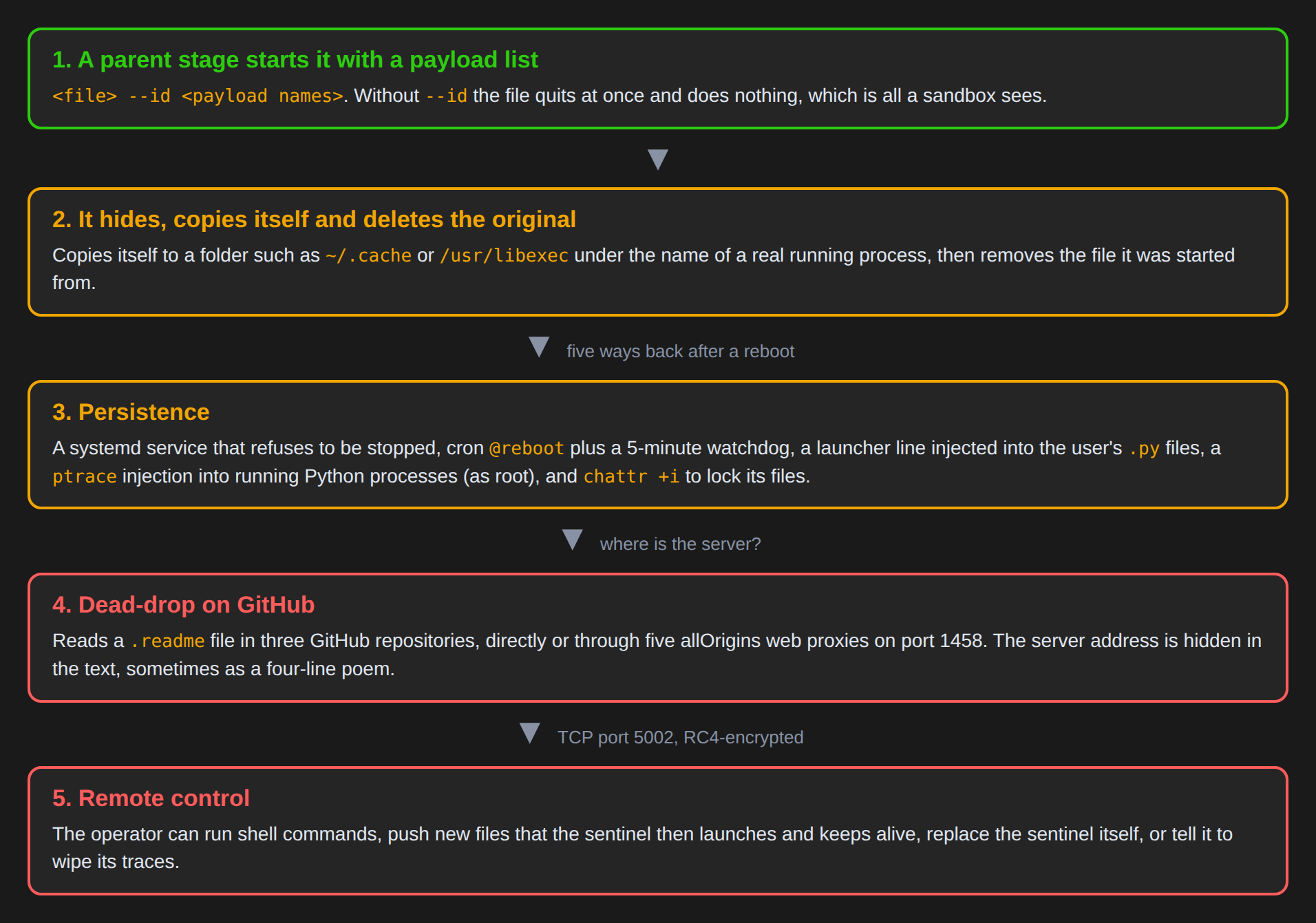
Automated sandboxes run a file and watch what happens. This one exits straight away unless it is started as <file> --id <names>, where the names are the programs it is supposed to look after. On Triage it ran without that argument, quit, and scored 1/10.
That tells us what the file is: a second stage. Something else, a dropper or the operator, puts it on the machine and starts it with a list of payloads. It also checks right at startup whether a debugger is attached (Linux reports this as TracerPid in /proc/self/status) and quietly exits if so.
Hiding in plain sight
The first thing the sentinel does is copy itself into a folder that looks like it belongs to the system, such as /usr/libexec, /var/lib/dbus, /opt or the user’s ~/.cache. Then it deletes the file it was started from. The copy gets the name of a process that is already running on the machine, with a letter added: in our test it picked bwrap and saved itself as bwrapd.
Payloads it receives later get the same treatment, or a name from a built-in list of ordinary Linux services such as polkitd, udisksd, upowerd or NetworkManager. Shells like bash are never borrowed, presumably because a "bash" that never takes input would stand out.
Five ways back
The sentinel sets up several independent ways to restart itself, so removing one isn’t enough:
- A systemd service (systemd is the program that starts services on most Linux systems). The service is set to restart one second after it stops, without limit. Its "stop" signal is
SIGCONT, a signal that does nothing to a running program, and the forced kill is switched off. In other words,systemctl stoppolitely asks it to continue. - Cron jobs (cron runs scheduled tasks): one at every reboot, plus a check every five minutes that restarts it if it is missing.
- Python script injection. It walks through the user’s home folder and adds one line near the top of every
.pyfile. That line silently starts the sentinel whenever the script runs. - Injection into running Python programs (only as root). It pauses a running
python3process withptrace, the same mechanism debuggers use. It then makes that process run one line of Python that starts the sentinel, and lets it continue as if nothing happened. - Locked files.
chattr +imakes a file immutable, so even root can’t delete it without unlocking it first.
A server address written as a poem
The sentinel has no server address built in. It carries a list of 18 web addresses, hidden with simple XOR encoding (each byte flipped with the same key byte). They point to three .readme files in GitHub repositories named after real projects (umbrel, deepin-wine-ubuntu and discord.js). Each file can be fetched directly or through five allOrigins servers on port 1458. allOrigins is an open-source "fetch this page for me" proxy, and the sentinel’s code expects exactly its reply format.
The file contents are a dead drop: an innocent-looking place where the operator leaves a message that the malware knows how to read. The sentinel accepts three formats:
- a plain IP address;
- four small numbers hidden in ordinary sentences;
- a four-line poem.
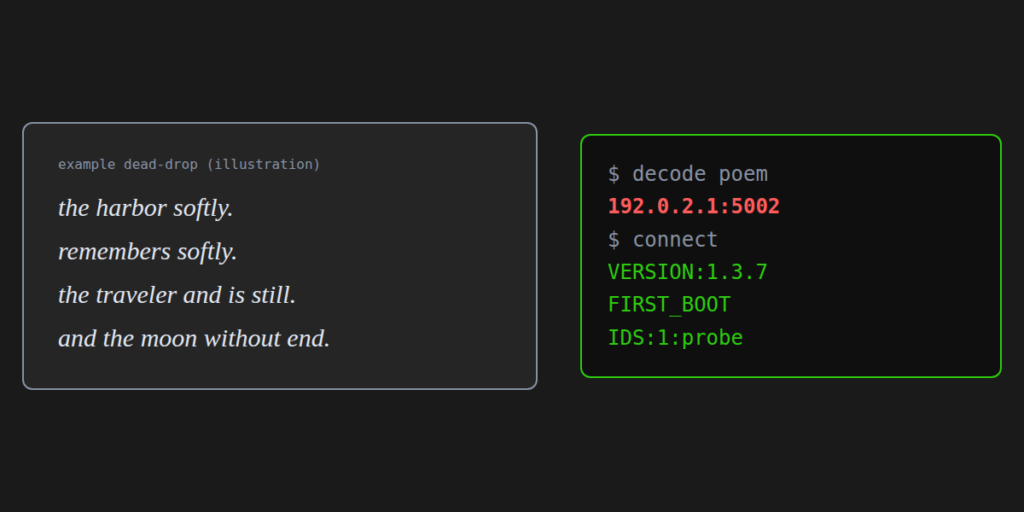
The poem is the clever one. Each line is a short phrase followed by an ending such as "softly." or "beneath the stars.". The phrase chooses the first half of one number and the ending the second half, so four lines give four numbers: an IP address. The vocabulary is fixed inside the program, so defenders can decode a poem by hand.
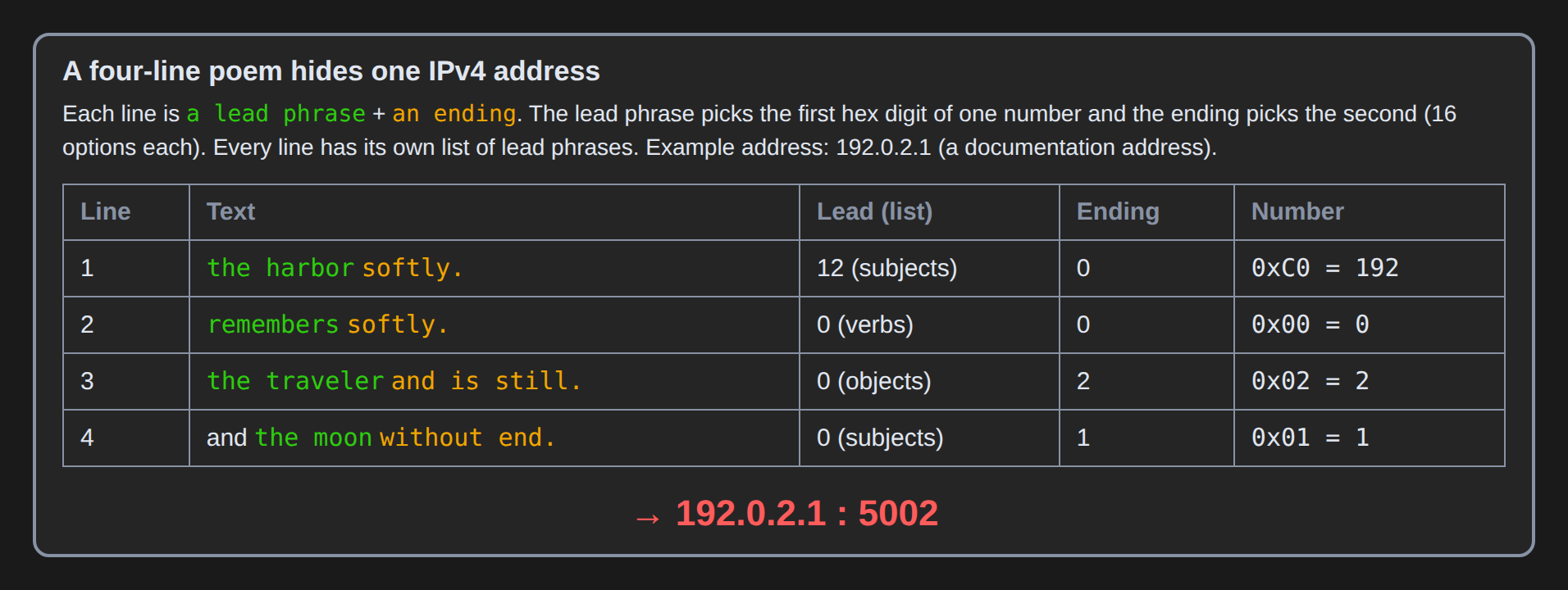
The four word lists, in order (position 0 to 15):
| List | Used on | Entries |
|---|---|---|
| Subjects | lines 1 and 4 | the moon, a river, the wind, an old road, the sea, a sparrow, the rain, a lantern, the morning, a shadow, the snow, a candle, the harbor, a mountain, the dusk, a quiet garden |
| Verbs | line 2 | remembers, forgets, follows, waits for, carries, answers, loosens, gathers, outlasts, mirrors, calls to, shelters, releases, circles, warms, watches over |
| Objects | line 3 | the traveler, every name, a single light, the long winter, your footsteps, the open door, a half-sung song, the first frost, all that was lost, the distant town, a folded letter, the rising tide, an empty chair, the turning year, a sleeping child, the quiet hour |
| Endings | every line | softly., without end., and is still., as the years pass., in the cold., and asks for nothing., beneath the stars., once more., till dawn., and lets it go., through the dark., like a promise., and does not speak., where no one waits., for as long as it can., and that is enough. |
Line 4 always starts with "and ". Multiply the lead phrase’s position by 16 and add the ending’s position to get each number.
When we checked, all three GitHub accounts and repositories returned "not found", so we could not recover the real server address for this copy.
Talking to the server
Once it has an address, the sentinel connects on TCP port 5002 (unless told otherwise). Both sides swap four random bytes. Those bytes are mixed with a key hidden in the program to make two RC4 keys, one for each direction (RC4 is an old, simple stream cipher). After that, every message is plain text inside the encryption: VERSION:1.3.7, FIRST_BOOT, and the list of programs it is looking after.
To test this without touching the real infrastructure, we ran the sentinel in an isolated sandbox with no internet access. We pointed it at a small fake server of our own by planting a cached address in its shared-memory state file, and sent it commands. It answered every one the way the code said it would:
PING→PONGSHELL:ran our command and sent back the outputFILE_SENDsaved and started a test script, which it then watched overDELETE_TRACEkilled everything, removed its service and its own copy, and saidTRACE_DELETED
Other commands, read from the code: replace the sentinel with a new version, receive compressed files, add, kill or restart individual payloads, and switch to a new server address.
What we couldn’t see
- The real server and payloads. The dead drops are gone, so we don’t know which server this copy talked to or what it was supervising. Miners, proxies and remote-access tools would all fit the design.
- The parent stage. We only had the sentinel. Whatever installed it and chose the
--idlist was not part of the sample. - The proxies. Two of the five proxy servers currently answer as allOrigins version 2.7.0. Nothing we found shows whether the operator runs them or simply uses someone else’s, so treat them as places to watch, not as attacker servers.
- Family name. The code calls itself "sentinel", but we found no public reporting that ties this tool to a known family.
Advice
For regular users: this is not something you install by accident from a download page; it arrives as part of a bigger compromise. If you run Linux servers, keep SSH keys and passwords strong and patch exposed services: that is the usual way in for Linux malware.
For defenders, look for:
- systemd unit files that contain both
KillSignal=SIGCONTandSendSIGKILL=no, and a command line ending in--no-kill; - the shared-memory file
/dev/shm/.i2c_36589256(the name is the same on every machine); - files named
.snt,.snt.lckor.snt_upd; .pyfiles containing_o.path.exists(together withstart_new_session=True;- outbound requests to port 1458 of the form
/get?url=https://raw.githubusercontent.com/...readme, and outbound TCP to port 5002 that starts with 4 bytes out, 4 bytes back, then 134 bytes out.
Removing it means clearing all five persistence methods. Check service files, crontabs, Python files and lsattr flags before deleting the binary.
Indicators of compromise
| Type | Indicator | Note |
|---|---|---|
| SHA256 | 695be80a55df587f79508546c166276d345ffc3453f8da7beb256c38d4ded7bd | fzw9oq.exe (sentinel 1.3.7) |
| URL | hxxps[://]raw[.]githubusercontent[.]com/francoryt3/umbrel/refs/heads/master/packages/umbreld/source/modules/blacklist-uas/blacklist-uas[.]readme | dead drop (404) |
| URL | hxxps[://]raw[.]githubusercontent[.]com/alessio756/deepin-wine-ubuntu/refs/heads/master/deepin-wine-plugin-virtual_1[.]0deepin1_all/DEBIAN/control[.]readme | dead drop (404) |
| URL | hxxps[://]raw[.]githubusercontent[.]com/franchgamer34/discord[.]js/refs/heads/main/packages/api-extractor-model/src/items/NewAPi[.]readme | dead drop (404) |
| IP:port | 152[.]89[.]29[.]79:1458 | fetch proxy, ownership unconfirmed |
| IP:port | 104[.]152[.]186[.]146:1458 | fetch proxy, ownership unconfirmed |
| IP:port | 202[.]61[.]246[.]49:1458 | fetch proxy, ownership unconfirmed |
| IP:port | 159[.]223[.]42[.]40:1458 | fetch proxy (allOrigins 2.7.0), ownership unconfirmed |
| IP:port | 45[.]10[.]26[.]95:1458 | fetch proxy (allOrigins 2.7.0), ownership unconfirmed |
| Port | TCP 5002 | default command-server port |
| File | /dev/shm/.i2c_36589256 | state file, same name on every host |
| File | .snt / .snt.lck / .snt_upd | in the install folder |
Closing
Hiding a server address in a GitHub file is a well-worn trick; here it is written as verse instead of an IP address. If you come across one of these poems, the four word lists above are enough to read it. Thanks for reading, and if you have a copy of the stage that launches the sentinel, we would love to see it.